

Project update: Another Productive Weekend Preparing XV232 for Her Journey
Every working weekend brings XV232 another step closer to her relocation to the RAF Manston History Museum, and this weekend was no exception.
While one part of the team focused on testing our recently acquired Ground Power Unit (more on that in Tuesday’s update), the engineering team continued the careful and methodical work needed to prepare the aircraft for dismantling.
This weekend’s efforts centred on the starboard wing, where two important pieces of work moved significantly closer to completion.
Progress Across the Starboard Wing
Aileron Mass Balance Weights
The first task focused on the aileron mass balance weights.
The team successfully loosened all of the retaining bolts, an important milestone that will make their eventual removal much more straightforward.
Attention then turned to the final securing arrangement, where a split pin needed to be removed before work could continue. Although the engineers successfully straightened the legs of the split pin, it remained firmly in place and couldn’t quite be extracted before the end of the weekend.
It may sound like a small job, but these are exactly the kinds of engineering challenges that come with dismantling a complex aircraft while preserving every original component for future reassembly.
Starboard Yellow Gate Electronic Support Measures (ESM) wingtip pod
Alongside work on the aileron balance weights, attention also turned to the the starboard ESM pod
Mounted beneath each outer wing, these distinctive pods housed part of the Nimrod’s Yellow Gate Electronic Support Measures (ESM) system. Unlike radar, which actively transmits signals, the ESM system worked silently by listening for electronic emissions from ships, aircraft and ground-based radar installations.
By analysing those signals, the system could help identify, classify and locate potential contacts without revealing the Nimrod’s own position. This passive capability formed a vital part of the aircraft’s maritime surveillance and intelligence-gathering role throughout the Cold War and beyond.
As with many systems on the aircraft, these pods contain valuable and increasingly rare equipment, making careful removal essential.
Good progress was made this weekend, with the rear mounting bolts successfully loosened as part of the preparation for the pod’s eventual removal.
The remaining forward mounting bolt sits in an extremely confined area, making access particularly challenging. Although it wasn’t released this weekend, valuable preparation work has now been completed, reducing the amount of work required when the team returns.
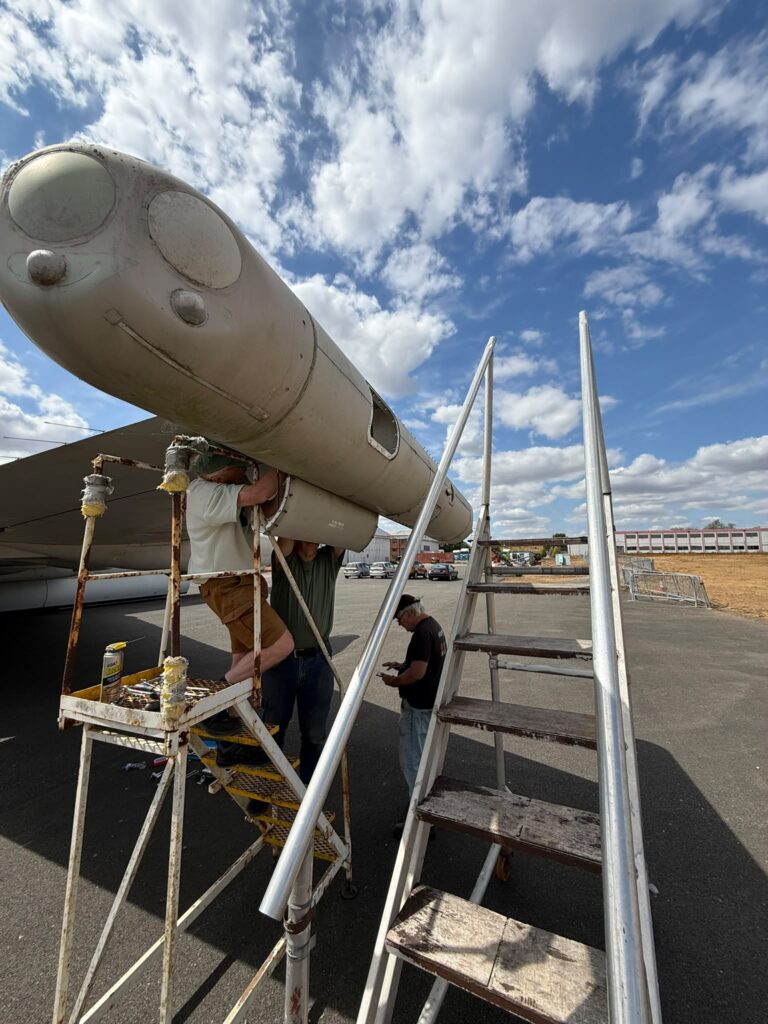
Why Does Progress Sometimes Look Slow?
Looking at these photographs gives an idea of why apparently simple engineering jobs can sometimes take hours rather than minutes.
Working beneath the wing pod means operating in extremely confined spaces, often with limited visibility and very little room to manoeuvre tools. Many of the fasteners haven’t been disturbed since XV232 left RAF service, so every stage requires patience, teamwork and careful planning.

Today’s volunteers are carrying out this work using general engineering equipment, mobile access towers and step ladders.
When Nimrods were in RAF service, the teams at No. 6 Maintenance Servicing Unit (NMSU) at RAF Kinloss had purpose-built maintenance docks, specialist access equipment and dedicated tooling designed specifically for major servicing of the aircraft.
Our volunteers don’t have that luxury.
Instead, they’re relying on decades of engineering experience, careful planning and a determination to preserve XV232 without damaging the aircraft or its irreplaceable components.
Seeing our volunteers working in these conditions also gives us an even greater appreciation of the skill and professionalism of the engineers who maintained the Nimrod fleet throughout its RAF service. While they benefited from specialist facilities and equipment, it was their knowledge, experience and teamwork that kept these remarkable aircraft available for operations around the world.
We’re incredibly fortunate that many of those former Nimrod engineers continue to support the XV232 project today, sharing their expertise, advice and encouragement with our volunteer team.
Every Weekend Moves the Project Forward
Projects like this are built on hundreds of individual engineering tasks that rarely make the headlines.
Every bolt loosened, every challenge overcome and every hour volunteered brings XV232 another step closer to beginning the next phase of her journey to the RAF Manston History Museum.
A huge thank you to everyone who gave up their weekend to support the project. Your knowledge, patience and teamwork continue to make remarkable progress possible.
The coming week promises to be another exciting one for the project, with several important activities planned that we hope to share with you very soon.
And if you think that’s been the highlight of the weekend…
Wait until you see what happened when we connected power to a Ground Power Unit that hadn’t been used for nearly 18 years.
We’ll be sharing that story on Tuesday.