

Planning the Big Lifts – The Next Engineering Challenge for XV232
Taking a Nimrod apart isn’t simply a matter of starting at one end and removing everything that looks detachable.
As planning for XV232’s relocation develops, the engineering team is now concentrating increasingly on the sequence in which the aircraft’s largest components must be removed — and on the equipment needed to do it safely.
That includes the engines, tailplane, fin, tail fairings and ultimately the wings themselves.
Preparing for engine removal
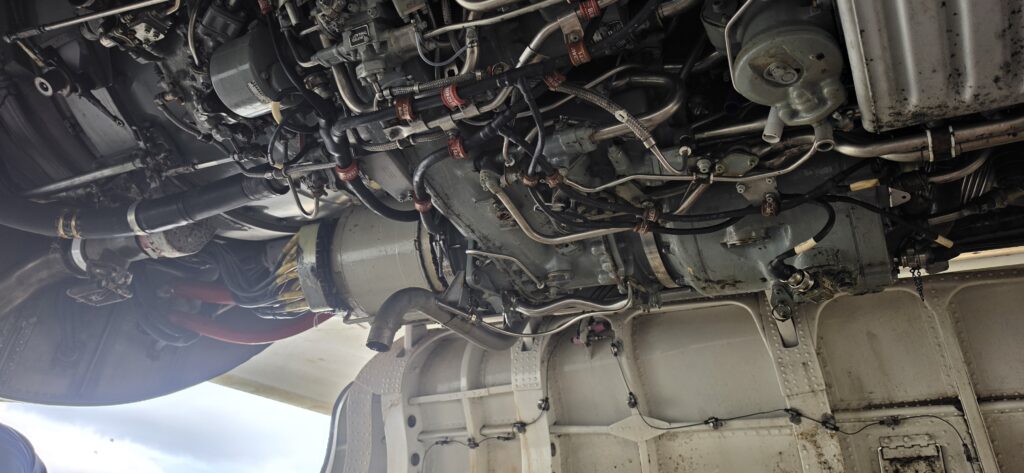
Work on No.4 engine is already partially advanced, but the latest engineering discussion highlighted several additional tasks that need to be completed before an engine can be extracted safely.
The CSDU and generator need to be removed, and the large electrical connections must be carefully identified and marked before disconnection.
The team also has to account for the physical movement of the engine itself.
A Spey cannot simply be lowered vertically out of the aircraft. The engine has to be controlled and rotated as it comes down to clear the surrounding structure.
The engine spreader bar available to the project has been reviewed positively, while additional tested block-and-tackle equipment is being investigated to give greater control during the operation.
Former Nimrod and Spey technicians are also being approached for specialist knowledge and tooling.
There’s an order to taking a Nimrod apart
Another important point raised during the engineering review concerned the tail.
The fin, tailplane and associated structure may need to come off before the wings are removed.
Why?
Because removing large structural components changes the aircraft’s balance and its response to wind.
Taking the wings away while leaving substantial structure high on the fuselage could create an unnecessary stability risk.
The team is therefore looking carefully at the removal sequence and at the fuselage cradles that will eventually support XV232 once she is no longer sitting conventionally on her undercarriage.
Original Nimrod cradle drawings are being reviewed, and enquiries are being made to see whether suitable existing cradles can be sourced.
Working at height on the tail will also require appropriately qualified contractors rather than simply relying upon the volunteer team.
Engineering before headlines
These are exactly the areas where careful planning matters.
Our objective isn’t simply to get XV232 apart.
It is to dismantle her in a way that allows her to be transported, preserved and reassembled, with the longer-term ambition of returning as much functionality as practicable once she reaches RAF Manston History Museum.
That’s a very different proposition from dismantling an aircraft for scrap.
And it comes with very different engineering and financial requirements.
Specialist contractors, certified lifting equipment, fabricated cradles, cranes and transport all cost money.
If you’ve been following the project and wondering when your donation makes a difference, this is exactly where it does.
👉 Help fund XV232’s next engineering stage: Save Nimrod XV232